
Lewis County Civil Docket Searches
The court itself offers no online civil search form. Circuit Court Clerk Barbara Hinson holds the Circuit records and minutes. Clerk & Master Kaitlin Bates serves as the legal custodian for Chancery and runs Probate Court. General Sessions civil cases move through the Circuit Clerk channel. Still, the exact reach of that court's civil jurisdiction turns on Tennessee law and local acts. So match the office to the court named on your summons, warrant, order, or notice. Guessing from the type of dispute leads people astray.
Access happens the old-fashioned way. That means a phone call, a trip to the right Justice Center counter, or a written copy request the clerk approves. The county pages publish no public terminal, mail procedure, online document viewer, or response time. Nail down those details before you send any money.
- Identify Circuit, Chancery, Probate, or General Sessions from the most recent court paper.
- Collect the full party names, case or warrant number, approximate filing year, and requested document date.
- Call 931-796-3724 for Circuit or General Sessions, or 931-796-3734 for Chancery and Probate.
- Ask for the current status, next setting, recent order, and whether any part is sealed or restricted.
- Confirm inspection, written-request, payment, and certification instructions before ordering a copy.
Lewis County Circuit or Chancery Civil Dockets
Two offices at 29 West Main Street divide the civil workload. The Circuit Court Clerk keeps Circuit records and minutes. The Clerk & Master holds the Chancery rule and execution dockets, plus minutes, filings, pleadings, exhibits, process, orders, and appeal records. That same office handles estates, guardianships, conservatorships, and annual accountings for Probate Court. No unified web index ties these streams together. So a search on a surname alone will not bridge them. You need the court as well as the name.
| Likely stream | Starting office | Published contact |
|---|---|---|
| Circuit civil | Lewis County Circuit Court Clerk | 931-796-3724 |
| Chancery or Probate | Lewis County Clerk & Master | 931-796-3734 |
| Limited civil claim | General Sessions through Circuit Clerk | 931-796-3724 |
The official Lewis County Clerk & Master page spells out the Chancery and Probate duties. It also links the local rules, a summons form, and current court-cost material.
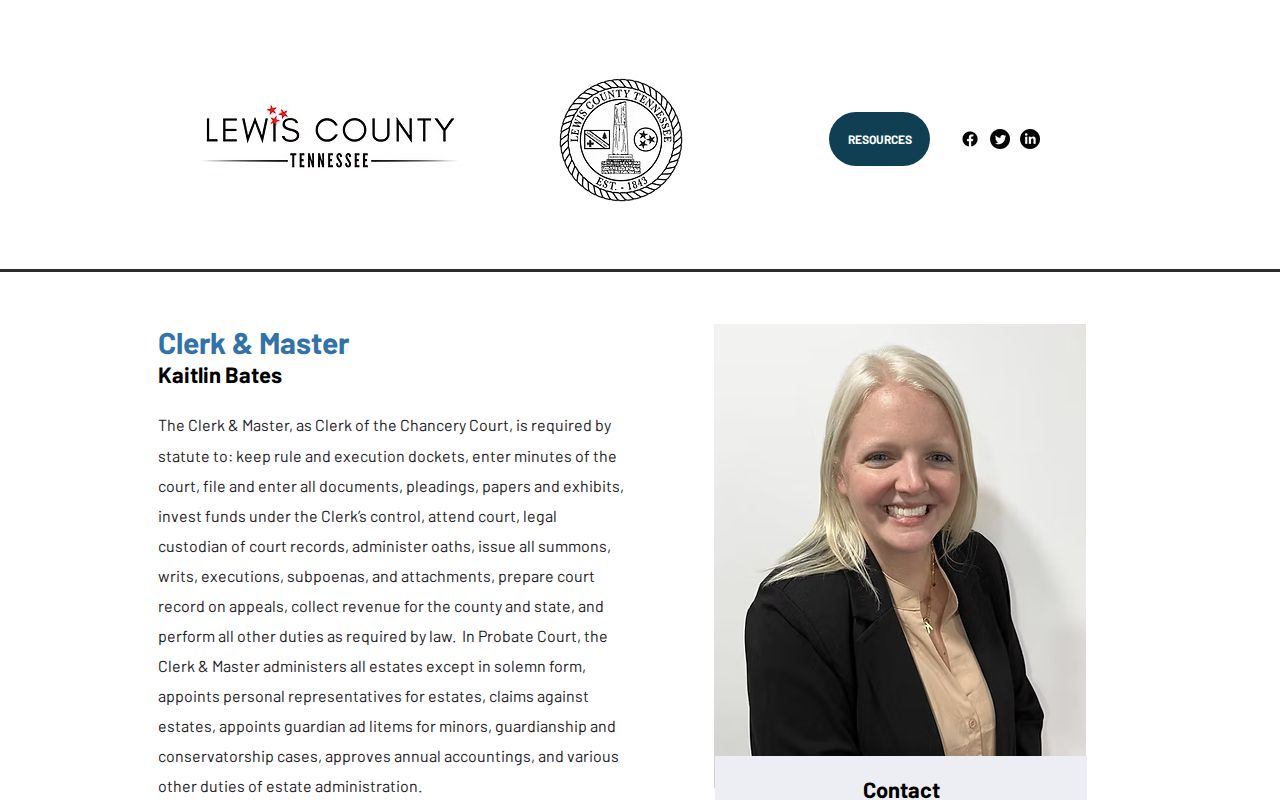
Those materials help with filing and court structure. Still, the office provides no public civil docket search box.
Civil Dockets: What They Show
A Lewis County civil docket lays out procedural events in date order. It may name a document without letting you view the document online. Start with the caption and the court. Then trace service, the response, motions, hearings, and signed orders one after another. The county publishes no universal civil-number format or abbreviation key. So a label can leave you guessing.
| Case identity | Court, case number, filing date, caption, assigned judge, and current status. |
|---|---|
| Parties | Plaintiff or petitioner, defendant or respondent, any intervenor, and attorneys of record. |
| Opening papers | Complaint or petition, summons issuance, return of service, and answer or response. |
| Case activity | Motions, responses, discovery-related entries, notices, settings, and signed orders. |
| Outcome | Settlement order, agreed judgment, default, nonsuit, dismissal, trial judgment, or another disposition. |
| After judgment | Execution, garnishment, satisfaction, appeal notice, and preparation of an appellate record where applicable. |
Lewis County Civil Docket Summons and Service
The locally posted Chancery summons shows why service dates matter so much. Its fields carry the case number. They also list the parties, the issue and service dates, the plaintiff's attorney information, the court name, and the Clerk & Master's signature. It also gives a 30-day instruction for presenting a defense after service. Keep the document's role straight. It is process issued in a case, not a records-request form and not proof of judgment.
For the official form context, the 32nd Judicial District local materials and civil summons are the source. Read service first, then the answer or response, before touching later default or motion entries. When a docket entry confuses you, do one thing: request the return of service and the signed order rather than trusting a label.
What Cases Fill the Civil Docket
Which Lewis County civil docket holds your case? It depends on the claim and the relief sought. Circuit Court hears civil matters as a court of record. Chancery takes equity and domestic-relations work, and the Clerk & Master administers Probate matters. General Sessions carries only limited civil jurisdiction. Lewis County posts no claim-by-claim jurisdiction chart. So ask the clerk where a small claim or a possession action belongs instead of assuming a division.
- Contract, debt, tort, and property disputes assigned to the proper civil trial court
- Equity and domestic-relations proceedings handled through Chancery
- Estate administration, guardianships, conservatorships, and accountings in Probate
- Limited civil claims within General Sessions jurisdiction
- Post-judgment execution and garnishment activity tied to an existing judgment
Lewis County Civil Docket Outcomes
Outcome words are not interchangeable. An agreed judgment reflects terms the parties accepted and the court entered. A default means nobody defended after proper service. A nonsuit is the plaintiff's voluntary dismissal, while a dismissal can rest on other grounds. "DWOP" signals dismissal for want of prosecution only when the clerk actually uses that term. A judgment for one side is a merits result. The signed document controls the exact relief.
Judgment The court's enforceable decision resolving a claim. Abstract A recorded notice of a money judgment, not the full judgment document. Execution A post-judgment enforcement process the clerk tracks. Garnishment A post-judgment process aimed at funds or property held by another party.
Kaitlin Bates's office specifically maintains the rule and execution dockets. Don't read a later garnishment or satisfaction entry as a new ruling on the original claim.
Hearings on the Civil Docket
A notice of hearing or setting records a planned event. It is not a ruling. Lewis County's published FAQ says the General Sessions Civil date appears on the warrant. A Circuit Court date comes from the attorney. Confirm Chancery and Probate settings with the Clerk & Master. Note that the county posts no official daily trial calendar or settings-search page.
Check each later entry for a continuance, reset, cancellation, or signed order. Ask whether the date still stands. Ask what kind of setting it is, and whether a new notice controls. In a Circuit case with counsel, the county FAQ says begin with counsel. Confirm through the clerk when needed. The full date-finding process is laid out in the Lewis County court schedule.
Lewis County Civil Appeal Dockets
Tennessee Public Case History earns its keep once an appeal is on file. For a Lewis County civil docket that has reached an appellate court, the civil detail screen can lay out the appellate number, case style, originating trial court, trial judge and number, and the milestones that mark the appeal's progress. Party roles and counsel appear there too. The event history tracks each filing and order. Selected PDF links let you open some records directly.
Limits remain. The screen may list technical records, transcripts, or exhibits. Yet it will not carry every trial-level financial field, and not every document downloads. For a feel for the layout, an official Tennessee civil appellate detail page from the courts' own site omits private names in this instance.
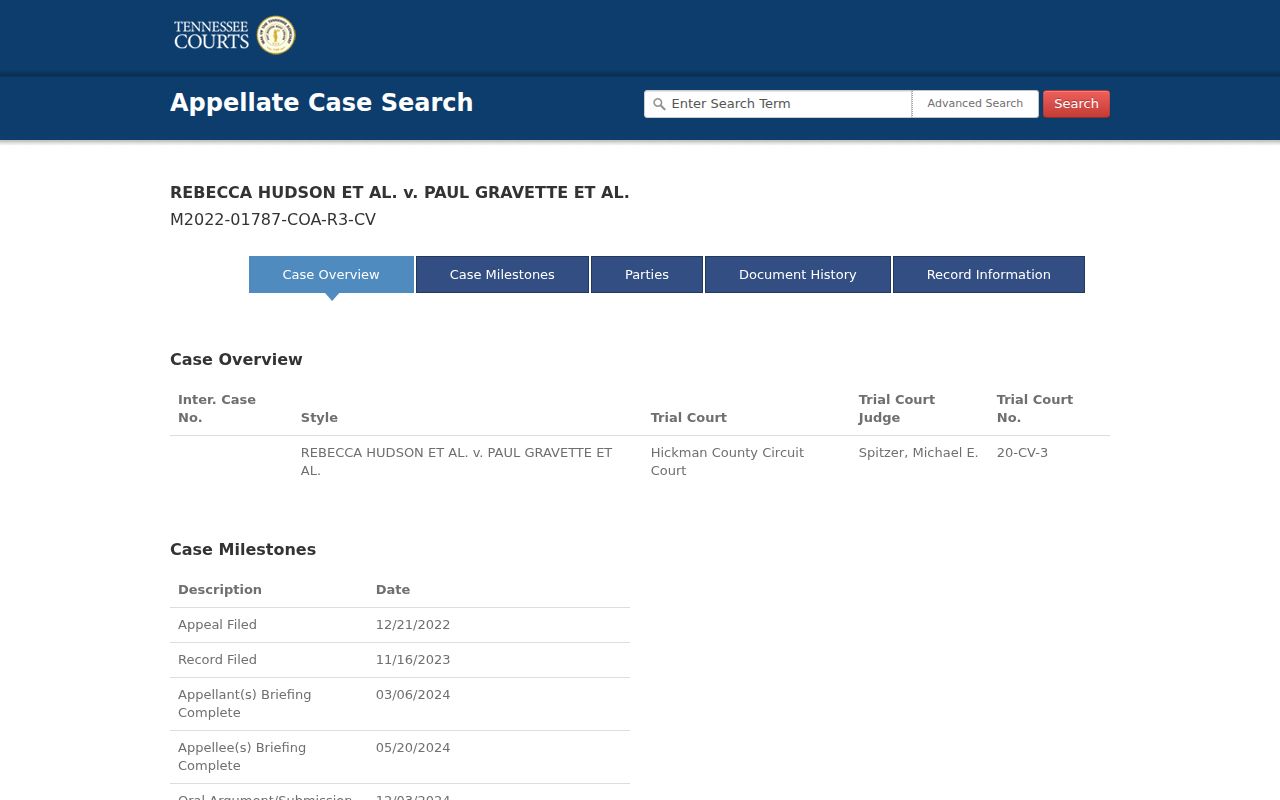
The appellate screen carries the trial-court number. Take that number back to the Lewis clerk to pull original pleadings, the judgment, financial entries, or a certified copy of anything in the underlying docket file.
Who Can See Civil Dockets
Lewis County civil court records are presumed open. Sealing, confidentiality, redaction, and similar legal limits still apply. Before a civil record is sealed, Tennessee Rule of Civil Procedure 1A demands a serious and substantial interest that outweighs openness. No less restrictive means may be available. Tennessee Supreme Court Rule 34 sits alongside it. That rule defines case records and the general framework for public access. The courts publish the official Tennessee Rule 1A sealing material for anyone who wants the rule's exact text.
A sealed entry is not proof the case never existed. The same goes for a protected filing or a missing image. Ask the holding clerk whether a public docket line, a redacted document, or an access order is available.
Key rules:
Tennessee Supreme Court Rule 34 generally allows access to case records unless law, rule, or court order makes them confidential.
Tennessee Rule of Civil Procedure 1A sets the open-record presumption and the standard for sealing a civil court record.
Tennessee Code Annotated section 10-7-503 reference states the public-record framework for Tennessee citizens, subject to confidentiality laws.
Lewis County Civil Docket Copies
A docket description tells you what happened; an authenticated document proves it. For copies, the Circuit Court Clerk prices regular copies at $0.50 per page and certified copies at $5.00 plus $0.50 per page. Ask whether that certification fee applies per document. Ask whether these rates govern the record you want. The Clerk & Master posts a 2026 Chancery and Probate costs sheet. It includes a computer-search or public-record-request line, so confirm that figure with the office directly.
When you order, give the proper clerk the exact document title and date. Include the page count, the current total, accepted payment, delivery method, and turnaround. The county publishes no civil copy-request form, no general mail procedure, and no promised processing time. Old files raise other questions. Ask about paper books, indexes, microfilm, or archived records. The Lewis County Public Library and Archives can help with historical research. Still, the trial clerk remains the official holder of the court docket.